


"A story of love, resilience, and surviving the trauma of war"
synopsis
Ball Lightning, a 12 minute frame by frame animation, follows the story of Gusta, a refugee who fled the personal and social effects of Soviet run East Germany after the end of WWII and emmigrated to the United States in the 1960s. The story is told through the eyes of the surrogate daughter that she raised after she was forced to give away her own infant daughter as the iron curtain rose. Gusta serves as an example of survival, kindness and the fortitude of human resilience. The film is dedicated to her lost daughter, Esther, a reminder that the children separated from families because of war are never forgotten by those who love them.
Director's Note: The film was created with a team of student interns, recent alumni, and faculty of Lesley University’s College of Art and Design. It is a collaborative project between colleagues as well as an educational tool for animation students. This project helped to create a community when we were mostly homebound by COVID. The film is a dual memoir and biography. It is based on a true story, and researched history of the main character, Gusta a 65 year old immigrant who left Soviet occupied East Germany in the 1960's. I was inspired to create this film during the COVID-19 lock down when I realized that the most compassionate person in my life had survived the pandemic of 1918, fascism, and much more – emerging as the loving mother illustrated in my film.
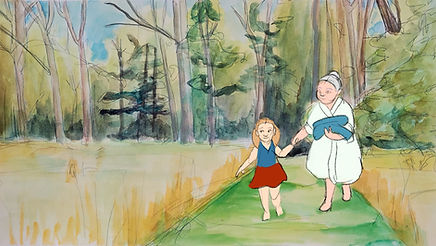
Process: The format for this film is frame-by-frame animation, with a kinetic, tactile approach towards the materials to highlight place and time, meant to evoke the process of combining fragmented memories into a singular, cohesive narrative. Ball Lightning combines traditional mediums such as oil paint, gouache, and watercolor paintings with computer-generated platforms, including TV Paint, Photoshop, and Procreate. The chosen medium for this film directly reflects its dual function as memoir and biography. The memoir portion is depicted from a child’s perspective and is meant to evoke a visual diary (or, sketchbook) to highlight the ephemeral quality of childhood memory. The hand drawn, pose-to-pose animation on watercolor backgrounds evokes the innocence associated with childhood. This light, gestural and colorful style stands in direct contrast to the heavier, oil paint on panels that are used to represent Gusta’s former life in Germany. The straight-ahead oil on panel animation is shot against a wall, to allow gravity to affect the images and show the kinetic drip of paint. This highlights the purposeful use of paint as a physical, tactile, and uncontrollable medium, meant to emulate the chaos and trauma of Gusta’s life.

Collaboration & Success
"Faculty Spotlight: Professor Catriona Baker’s Film Ball Lightning Shines on International Stage"

process
The format for this film is frame-by-frame animation, with a kinetic, tactile approach towards the materials to highlight place and time, meant to evoke the process of combining fragmented memories into a singular, cohesive narrative. Ball Lightning combines traditional mediums such as oil paint, gouache, and watercolor paintings with computer-generated platforms, including TV Paint, Photoshop, and Procreate. The chosen medium for this film directly reflects its dual function as memoir and biography. The memoir portion is depicted from a child’s perspective and is meant to evoke a visual diary (or, sketchbook) to highlight the ephemeral quality of childhood memory. The hand drawn, pose-to-pose animation on watercolor backgrounds evokes the innocence associated with childhood. This light, gestural and colorful style stands in direct contrast to the heavier, oil paint on panels that are used to represent Gusta’s former life in Germany. The straight-ahead oil on panel animation is shot against a wall, to allow gravity to affect the images and show the kinetic drip of paint. This highlights the purposeful use of paint as a physical, tactile, and uncontrollable medium, meant to emulate the chaos and trauma of Gusta’s life.
oil on panel


.jpg)


TV Paint on Gouache backgrounds




This film was funded in part by grants from ASIFA Hollywood Animation Educators Forum, the Cambridge Cultural Council as part of the Massachusetts Cultural Council, and Lesley University.


